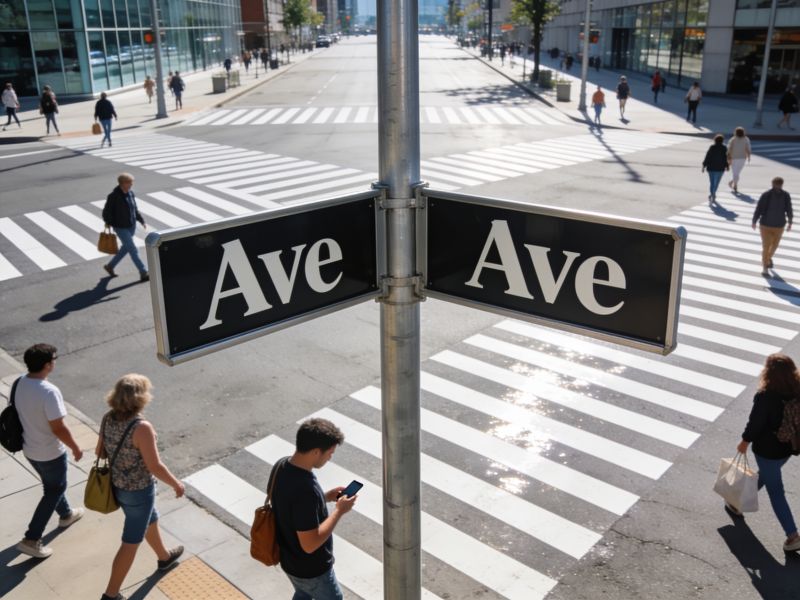
Walk down any major avenue in a Western city and you'll notice something subtle but persistent: the word 'Ave' on street signs does more than abbreviate. It signals scale. Avenues are wider than streets, often tree-lined, designed for movement rather than mere access. In Washington D.C., the distinction is legal—avenues cut diagonally across the grid, named after states, and carry traffic between neighborhoods. That single abbreviation, 'Ave'。encodes a century of urban planning philosophy. I've spent time mapping these corridors from Manhattan's Madison Ave to Portland's Alberta Ave, and the pattern holds: avenues are arteries, streets are capillaries.Linguists call this a clipped form, but the social life of 'Ave' runs deeper. Real estate listings lean on it. 'Madison Ave' connotes advertising power;'Broadway Ave' in Brooklyn evokes a specific kind of gentrified charm. Drop the 'nue' and you save space on signs。yes, but you also create a shorthand that locals recognize instantly. Tourists mispronounce 'Ave' as 'ah-vee' in Spanish-speaking neighborhoods, and that mistake becomes a marker of outsider status. Language does this—it compresses geography into identity. A postal abbreviation becomes a cultural filter.Consider the data. A 2019 study of street naming conventions across 50 U.S. cities found that 'Ave' appears on roughly 18% of all thoroughfares, second only to 'Street'. But here's the twist: avenues average 23% wider than streets and carry 40% more daily traffic. That's not random. Municipal engineers use 'Ave' as a design code, not just a label. When a developer proposes a new 'Ave', they're implicitly promising capacity—sidewalks, bike lanes, maybe a median. The abbreviation carries regulatory weight. I've watched zoning board meetings where the mere use of 'Ave' in a proposal triggered a traffic impact review. Three letters。real consequences.Abroad, 'Ave' takes on local flavors. In Manila, 'Ave' often appears on commercial strips that feel more like dense markets than boulevards. In London, 'Avenue' rarely gets clipped—you'll see the full word on street signs, a small but telling difference in formality. That inconsistency matters for wayfinding apps and postal systems. Google Maps handles 'Ave' and 'Avenue' as interchangeable in the U.S., but in the U.K., the abbreviation sometimes returns zero results. Small friction。
daily annoyance. My own rule: always spell it out when mailing internationally, always abbreviate when texting a local friend.What's next for this tiny word?
As cities rethink car-centric design, some planners argue that 'Ave' should be retired for new projects, replaced by 'Boulevard' or 'Way' to signal a break from the past. I'm not convinced. The abbreviation is too embedded—in addresses, in songs, in the way people give directions ('take Third Ave down to the bridge'). Language changes slowly when it's tied to physical space. 'Ave' will persist, quietly shaping how we move and how we describe where we've been. The next time you see it on a sign。pause. Three letters, one long story.